




SmartSafe CNC605+ V2 Injector Cleaner & Tester | 6-Cylinder EFI/GDI/PIEZO
6.500,00 SAR
The SmartSafe CNC605+ V2 is a professional 6-cylinder bench injector cleaner and tester. It combines ultrasonic cleaning with microcomputer-controlled fuel pressure so technicians can simulate engine conditions and inspect injectors in EFI, GDI, and PIEZO operating modes.
Workshops can move injector service from guesswork to a measurable process: resistance testing, ultrasonic cleaning, leakage checks, spray observation, injection-quantity measurement, automatic test sequences, and EFI on-vehicle cleaning with the supplied-style adapters described in the official manual.
Supplied in Saudi Arabia through Launch Gulf, the exclusive SmartSafe distributor: 2-year warranty, 2 years of free updates, a free hands-on training course, and specialist after-sales support for setup and technical issues.
Add a documented injector cleaning and testing service to your workshop — with official support behind the machine.

200 in stock
SmartSafe CNC605+ V2 injector cleaner and tester for professional workshops
When a customer reports poor acceleration, hard starting, high fuel use, or an uneven idle, injectors are often in the suspect list. A removed injector still cannot be judged by eye alone. It may be carbon-restricted, it may dribble under pressure, it may deliver a different quantity from the rest of the set, or it may produce a poor spray. Without a proper cleaner and tester, a workshop is left guessing: replace injectors, or run a chemical flush that produces no measurable result to show the customer.
The SmartSafe CNC605+ V2 is a bench-top injector cleaner and tester for up to six injectors, from SmartSafe The official user manual describes it as a mechatronic unit that combines ultrasonic cleaning with microcomputer fuel-pressure control. It can simulate a range of engine operating conditions and then clean and test injectors. That is the practical difference: not rinsing only, but a documented path — resistance test, ultrasonic cleaning, leakage test, uniformity and spray observation, injection-quantity measurement, automatic mode, and on-vehicle cleaning in EFI mode.
This page is a technical and commercial reference for workshops and service centres. Specifications and functions below are taken from the official manual. No extra capacity, voltage, or feature is attributed to the machine unless the manual states it. General workshop knowledge is used only to explain why a function matters, not to invent product data.
What is the SmartSafe CNC605+ V2?
SmartSafe CNC605+ V2 (the operating manual used for this listing is the official CNC605+ manual) is a desk-type 6-cylinder injector cleaner and tester. It is intended for professional technicians and maintenance personnel, not home use. The working idea is straightforward:
- Select the injector type: EFI, GDI, or PIEZO.
- Connect injectors to the pulse signal leads and the fuel distributor with the correct adapter.
- Run a cleaning and testing sequence using the available pressure, RPM, pulse-width, and timing ranges.
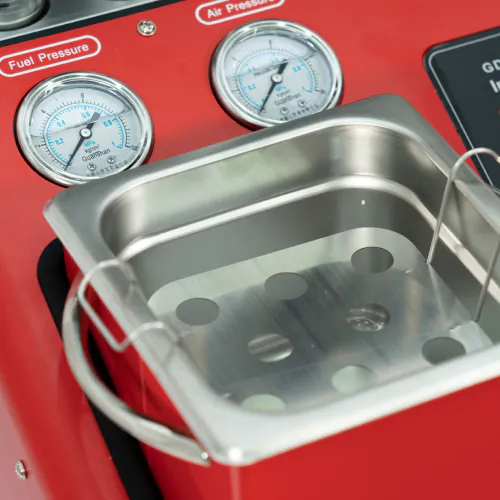
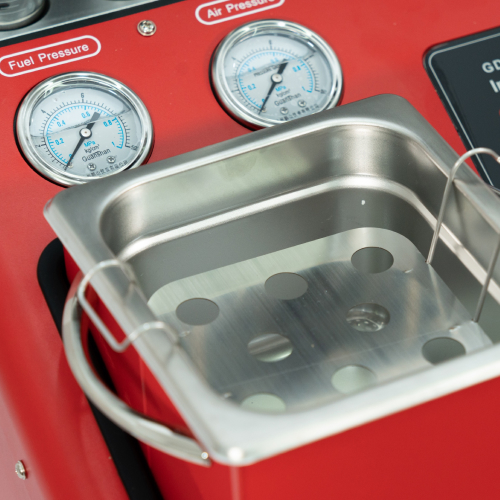
According to the manual’s structure diagram, the unit includes a fuel/test-solution tank, fuel pump, filter, fuel distributor assembly, ultrasonic cleaner bath, transparent glass tubes for uniformity and spray observation, a pressure gauge, a control panel, pulse signal leads, and a power switch and socket. Test solution is used for uniformity/spray, leakage, injection-quantity, and auto-mode tests. Ultrasonic detergent is used in the ultrasonic bath. Neither fluid is included in the standard configuration; they are purchased separately.
The machine is described as applicable to vehicles with a variety of gasoline injection systems within its adjustable pressure range. On-vehicle cleaning without full injector removal is available in EFI working mode only, using a variety of disassembly-free connectors.
How it differs from a generic “injector cleaner”
Many products sold as injector cleaners are ultrasonic tanks only, or simple flow benches with no clear test path. The CNC605+ V2, per the manual, combines both jobs: ultrasonic cleaning of multiple injectors, and testing under adjustable system pressure, with microcomputer automatic control and digital display of main status parameters, plus an automatic sequence that simulates several operating conditions. That is what makes it a workshop service tool rather than a generic bath.
Why a workshop needs an injector cleaner and tester
An injector is a precision part. Carbon, gum, dust, and fuel-path debris change spray shape, delivered quantity, and sealing. The manual notes that after a period of use the fuel supply system can clog, and that combustion deposits readily adhere to injectors, ports, hoses, the throttle, and the combustion chamber. On the vehicle that shows up as a poor mixture, incomplete combustion, and cylinder-to-cylinder imbalance.
For the workshop the value is practical:
- A clearer technical decision: Is the injector dribbling? Is quantity uneven? Is electrical resistance abnormal?
- A sellable service: injector testing and cleaning as its own job line, instead of defaulting to expensive replacement.
- A clearer conversation with the customer: you can explain that leakage, uniformity, and spray were checked, not that the part was “washed and refitted”.
No guaranteed revenue figure is claimed. Return depends on labour rates, workshop volume, and the mix of vehicles you see. The machine supplies a way to make the service measurable.
Main functions and features of the SmartSafe CNC605+ V2
The following items are from the official manual only:
- Desk-type cleaner and tester for up to six injectors.
- Ultrasonic cleaning combined with microcomputer fuel-pressure control.
- Simulation of various engine working conditions during cleaning and testing.
- Working-mode selection: EFI, GDI, and PIEZO.
- Resistance test of up to six injectors at once through the pulse signal line.
- Ultrasonic cleaning of multiple injectors to remove carbon deposits.
- Leakage and dribbling test under system pressure.
- Uniformity/spray test with backlight observation, plus reverse flush for top-supply injectors.
- Injection-quantity test of normal injection over 20 seconds.
- Auto mode that simulates several working conditions under set parameters.
- On-vehicle clean with disassembly-free connectors, EFI mode only.
- Stable, wide-range pressure adjustment for a variety of gasoline injection systems within the stated specification.
- Microcomputer automatic control and digital display with real-time monitoring of main status parameters.
- System settings: multiple languages, screen brightness, volume, factory reset, and software version display.
Official specifications
| Item | Value from the official manual |
|---|---|
| Machine type | Desk-type 6-cylinder injector cleaner and tester |
| Operating modes | EFI / GDI / PIEZO |
| Power supply | AC 110 V, 50/60 Hz or AC 220 V, 50/60 Hz |
| Mechanical power | 500 W |
| Ultrasonic cleaning power | 100 W |
| Fuel tank capacity | 2,500 ml |
| Working pressure | 0 to 9 bar |
| Simulation speed range | 100 to 9,900 rpm, step 10 rpm |
| Timing range | 1 to 9,999 s |
| Pulse width | 0.1 to 25 ms, step 0.1 ms |
| Resistance test range | 0 to 250 Ω |
| Operating temperature | 0 to 45 °C |
| Relative humidity | < 85% |
| External magnetic field | < 400 A/m |
| Workplace safety | Open flame prohibited within 2 m |
Figures not listed here — including weight, cabinet dimensions, or internal drive voltages not stated in this manual — are not attributed to the product on this page.
Injector cleaning technology
The manual describes ultrasonic cleaning as an advanced method that uses penetration and cavitation shock waves generated as ultrasound travels through the medium. That is suitable for complex shapes, cavities, and pores, and is used to remove stubborn carbon on the injector.
In workshop practice:
- Clean the injector exterior in gasoline or detergent, then wipe with a soft cloth.
- Place the injector in the ultrasonic tank with the needle-valve end down and the electrical connector end up.
- Add cleaning agent so the needle valve is immersed; the manual typically calls for the liquid level about 20 mm above the needle valve.
- Connect the pulse signal leads correctly.
- Select Ultrasonic cleaning, set time (default 600 s), and press Start.
Two critical warnings from the manual: never run the ultrasonic system with no cleaning agent in the bath, or the ultrasonic unit can be damaged. Never immerse the pulse-signal connector in the bath with the injector, or the connector can be damaged.
The machine also supports reverse flushing under Uniformity/Spray, limited to top-supply injectors via the reverse-flush connector. Test solution enters from the injector outlet and leaves from the inlet, helping wash internal dirt and deposits on the injector filter.
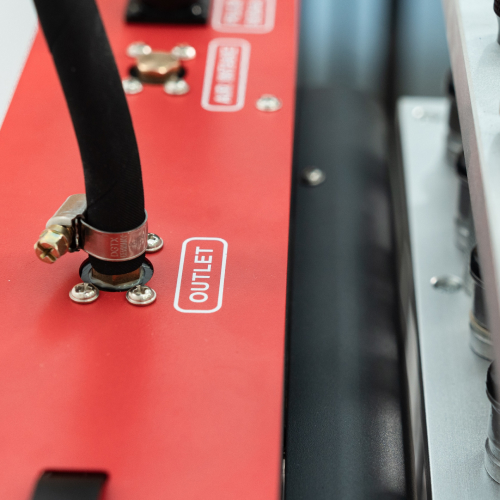
On-vehicle cleaning uses a detergent-and-fuel mix in the machine tank after confirming the tank does not contain test solution, then connecting the machine lines to the vehicle and running the engine during the cleaning cycle. This function is EFI only.
Injector testing: what the machine actually does
The CNC605+ V2 is not a vehicle ECU scanner. It is an injector cleaner and performance tester. Confirmed functions:
1) Resistance test
Through the pulse signal line the unit tests internal resistance of up to six injectors to judge circuit condition. A pass shows the resistance value under the injector number. SC indicates a short circuit. ERROR indicates a connection fault, poor contact, or excessive resistance. Warning: stop the system before plugging or unplugging the pulse signal line.
2) Leakage test
Checks needle-valve sealing under system pressure and whether the injector dribbles. Drain the transparent tube first if it contains test solution. Default time is 60 seconds. Pressure is typically set 10% higher than the injector manufacturer’s value using the pressurization and depressurization buttons. The manual’s typical reference: dribbling should be no more than one drop per minute (or per the injector’s technical spec).
3) Uniformity / spray
Uniformity testing checks whether injection-quantity differences among injectors from the same vehicle stay within an acceptable range under the same conditions. That reflects electrical characteristics, orifice-diameter change, and blockage. Spray testing observes atomization and injection pattern using the backlight. Pressure can be adjusted during the run, and the drain button can empty the tubes.
4) Injection quantity
Measures fuel injected normally over 20 seconds, then compared with the injector’s technical data or a reference injector within the allowed error. Quantity deviation reflects orifice wear or blockage while reducing interference from electrical-parameter changes.
5) Auto mode
Combines several methods, including a 15-second constant-injection quantity check within the sequence, idle, medium speed, high speed, variable acceleration/deceleration, and variable pulse width. Three modes:
- Mode 1: set pressure, inject normally for 20 s, then observe/drain stages, including 650 rpm at 3 ms pulse width for 2000 counts, 4500 rpm at 5 ms for 1700 counts, and 6000 rpm at 3 ms for 2000 counts, while observing injection angle, atomization, blockage, dripping, idle, medium, and high-speed behaviour.
- Mode 2: speed-change testing for 3 cycles, accelerating from 350 to 6000 rpm in 50 rpm steps and decelerating the same way, with duty-ratio changes.
- Mode 3: runs Mode 1 then Mode 2.
When the test ends, a buzzer sounds and the equipment stops automatically.
What the machine does not claim
It does not diagnose engine sensors, program control units, or guarantee that a mechanically worn or broken injector will return to new condition after cleaning. Its job is cleaning and testing as described above.
Compatible vehicles and injection systems
The manual does not publish a closed list of vehicle models. What it does confirm:
- Applicable to vehicles with a variety of gasoline injection systems within the adjustable pressure range.
- Injector operating modes: EFI, GDI, and PIEZO.
- A 6-injector bench, so one cycle can cover engines up to that count.
- On-vehicle cleaning: EFI mode only, with connectors for various models.
- An appendix lists reference fuel-system pressures for common brands as a working aid, not as a year-by-year homologation list.
Sequential fuel injection (SFI) is, in workshop use, a form of conventional electronic injection. The manual does not list a separate SFI mode. Those injectors are handled by identifying the injector type and selecting EFI when the injector is a conventional electronic unit. Selecting the wrong mode may damage the injector — an explicit manual warning.
Diesel or any system not stated in the manual is not claimed here. If injector type is unclear, check the injector datasheet or vehicle documentation before choosing a mode.
Using the CNC605+ V2 in a vehicle workshop
A typical job flow:
- Customer complaint: high consumption, misfire-like shake, weak acceleration, or mixture/combustion codes with injectors suspected.
- Basic vehicle checks (fuel pressure, visible leaks, filter condition, codes).
- If injectors will be tested: remove them, inspect rubber seals, and replace damaged seals before cleaning to avoid false leak results.
- External clean, then run the CNC605+ V2 path: resistance → ultrasonic → leakage → uniformity/spray → injection quantity → auto mode as needed.
- Record findings: dribble, uneven quantity, improved spray after cleaning, or an injector that should be replaced.
- Refit and road-test.
EFI on-vehicle cleaning can be offered when the goal is fuel-path maintenance without full injector removal, following hose-connection rules, leak checks, and fire precautions because detergent is flammable.
Place the machine on a level surface, in a well-ventilated room away from direct sun, more than 200 mm from walls, at 0–45 °C, away from fire, with a grounded outlet. The manual recommends forklift handling for transport, forbids long-distance mechanical handling while unpackaged, and limits inclination to 45°.
How to start and operate the machine
Summary from the manual — not a substitute for reading the full document before use:
- Move the packed machine to a flat surface and check packaging, machine, accessory box, manual, and power cord.
- Plug the power cord into the input on the right side.
- Confirm the outlet is grounded.
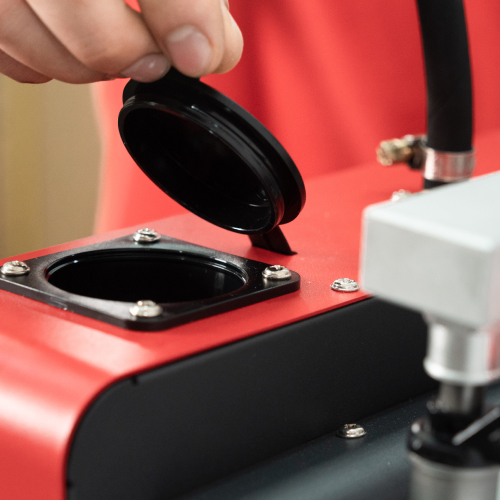
- Fill test solution from the upper-left filler. In most cases fill about 2,000 ml without crossing the warning line. Watch the level tube. Tank capacity is 2,500 ml.
- Add ultrasonic detergent until the injector needle valve is covered.
- Turn on the power switch on the right of the cabinet.
- On the mode screen select EFI, GDI, or PIEZO. Workflows and parameters differ; the wrong mode may damage the injector.
- Settings allow language selection, brightness, volume, software version, and factory reset (which clears user parameters).
After work: press the fuel-drain button to empty test solution into a container, switch off and unplug by the plug body (do not pull the cord), empty the ultrasonic bath completely and wipe it with a soft dry cloth, and wipe the table top. Drain the tank to avoid evaporation; reusable fluid should be stored safely, dirty fluid disposed of per regulations.
How to clean injectors on the CNC605+ V2
Preparation
- Remove the injector and check the rubber seal; replace it with the same type if damaged.
- Soak/clean the exterior, then wipe with a soft cloth.
- Confirm test-solution level in the tank.
- Prepare the ultrasonic bath.
Ultrasonic cleaning
- Place the externally cleaned injector on the bracket in the tank.
- Keep liquid typically about 20 mm above the needle valve.
- Connect pulse leads without immersing the connector.
- Select Ultrasonic cleaning, set time (default 600 s), press Start.
- The system stops automatically. Wipe injectors before the next test.
Reverse flush (top-supply injectors)
- Fit the reverse-flush connector and matching O-ring under the fuel distributor.
- Install the injector reversed (outlet up, inlet down).
- Tighten compression screws evenly.
- Drain the transparent tube if needed to prevent overflow.
- Connect the pulse line, set parameters, press Start, and adjust pressure with +/-.
On-vehicle clean (EFI only)
- Confirm the tank holds detergent, not test solution. Drain and, if heavily contaminated, dispose of it, then rinse with a small amount of test solution.
- Blend detergent with fuel per the detergent instructions. For a 6-cylinder engine the manual cites about 1,500 ml fill quantity.
- Connect lines with or without a fuel-return hose as shown in the manual. Cover pressurized unions with a towel when disconnecting.
- Disable the vehicle fuel pump (fuse or power lead) or join the disconnected ends as required so the vehicle pump does not run during service.
- Select On-vehicle clean, set time, press Start, then start the engine. Adjust pressure to the vehicle’s technical requirement. Stop can be pressed at any time.
- After cleaning, switch the ignition off, restore hoses, start the engine, and check for leaks while accelerating moderately.
- Clean the machine tank and lines with test solution: drain remaining detergent, add a small amount of test solution, connect the outlet hose to the return port, run Leakage test for about 2–3 minutes, then drain and dispose of fluid properly.
During on-vehicle cleaning the detergent is flammable. Keep an effective fire extinguisher ready and confirm there is no leakage before starting. Apply the handbrake, select neutral, and block the front wheel before this type of service, as the manual requires.
How to test injectors, step by step
Recommended official sequence:
- Resistance test
- Ultrasonic clean
- Leakage test
- Uniformity/spray test
- Injection-quantity test
- Auto mode test
Mounting injectors on the fuel distributor (pressure and spray tests)
- Select the correct connector and confirm the seal ring is sound.
- Fit the connector under the distributor.
- Install the injector in the forward direction with a little lubricant on the O-ring.
- Adjust and tighten both compression screws evenly.
- Connect the pulse signal line.
- Drain the transparent tube if it contains test solution.
The transparent tubes are glass. Keep other tools away so they are not scratched or broken. Disconnect tubes only after system pressure reads zero.
Who the SmartSafe CNC605+ V2 is for
- Vehicle repair workshops that want a measurable injector cleaning and testing service.
- Service centres handling gasoline vehicles with EFI, GDI, or PIEZO injectors.
- Technicians diagnosing mixture and combustion issues linked to injectors.
- Injector specialist benches that need a 6-cylinder ultrasonic-plus-pressure platform.
- Workshop owners who want to reduce guesswork replacement and explain results more clearly.
It is not for untrained home use. The manual states it is for professional technicians and maintenance personnel. It is not presented here as a full diagnostic scanner or as a diesel solution unless a later official source confirms that, which this manual does not.
Commercial value for the workshop
Without guaranteed financial claims, a workshop can use the machine to:
- Offer a named service: injector test and clean as a price-list item.
- Justify replacement: if an injector still leaks or is uneven after cleaning, replacement is easier to explain.
- Reduce disputes: the customer sees measure, clean, and re-check rather than a vague wash.
- Choose the method: full off-car testing, or EFI on-vehicle cleaning when that fits the job.
- Process up to six injectors on one bench: suitable for common 4- and 6-cylinder gasoline engines in one cycle up to six injectors.
Service quality still depends on technician training, correct fluids, and timely replacement of O-rings and filters. That is why the local offer includes Launch Gulf training and support, not the hardware alone.
Why choose the SmartSafe CNC605+ V2?
Buying a cleaner/tester is an operations decision. The fair comparison is not “best in the world”. It is whether the platform covers the workflow you need, with published specifications and local support.
- A documented product line: SmartSafe supplies a user manual, safety warnings, and maintenance procedures. That is different from a unit with no usable operating document.
- A written test path: resistance, ultrasonic, leak, spray, quantity, auto. Many low-cost options stop at a bath or an undocumented pump.
- EFI, GDI, and PIEZO modes: workshops seeing newer gasoline cars need more than one injector family, with the correct mode selected.
- Up to 9 bar and a wide simulation RPM range: adjustment within the published envelope, not an invented higher pressure.
- Local support when bought from Launch Gulf: warranty, training, updates, and a party the technician can call.
Less-documented machines may still handle simple jobs. The workshop risk is missing safety procedure, unclear fluids, and weak access to wear parts and support. This page does not invent defects for named competing models; it compares categories.
Comparison table: CNC605+ V2 versus common market categories
| Topic | SmartSafe CNC605+ V2 | Ultrasonic tank only | Low-cost undocumented test bench | On-vehicle chemical clean only |
|---|---|---|---|---|
| Machine type | Bench cleaner and tester, 6 injectors | Ultrasonic bath | Not confirmed (varies by model) | On-vehicle service without full off-car testing |
| Ultrasonic cleaning | Yes, 100 W per manual | Usually yes | Not confirmed | Not applicable |
| Pressure-controlled testing | Yes, 0–9 bar, microcomputer control | Usually no | Not confirmed | Not confirmed |
| Resistance test, up to 6 | Yes | No | Not confirmed | No |
| Leak / uniformity / spray / 20 s quantity | Yes, separate functions | No | Not confirmed | No |
| Auto mode | Yes, three described modes | No | Not confirmed | No |
| EFI / GDI / PIEZO modes | Yes, explicit selection | No | Not confirmed | Not confirmed |
| On-vehicle cleaning | Yes, EFI only, with connectors | No | Not confirmed | Yes as a service method |
| Reverse flush | Yes, top-supply, under Uniformity/Spray | No | Not confirmed | No |
| Control and display | Automatic control and digital main-status display | Often a simple timer | Not confirmed | Not applicable |
| Operating manual and safety | Detailed official manual | Not confirmed | Not confirmed | Depends on the chemical product |
| Local warranty and support | Launch Gulf: 2-year warranty, training, 2-year updates, technical support | Not confirmed | Not confirmed | Not confirmed |
| Best fit | Workshops that need measurement and testing | Limited pre-clean only | Not confirmed | Path cleaning without per-injector data |
| Value versus price | Offer price for an integrated bench plus local support; each workshop should judge by job volume | Usually lower cost, narrower function | Not confirmed | Consumable cost without test data |
“Not confirmed” cells are intentional. Competitor numbers are not invented.
CNC605+ V2 versus traditional injector cleaning
Traditional workshop practice is usually one of two things: an ultrasonic bath with no simulated pressure, speed, or pulse width, or a tank additive run on the engine with no knowledge of which injector dribbles or which one is off on quantity.
The CNC605+ V2 adds measurement: dribble over a timed leak test, side-by-side levels in the glass tubes, backlight spray observation, a 20-second quantity check, then an automatic sequence through idle, medium, and high speed. Traditional cleaning may improve a partly restricted injector. Testing is what stops a leaking or uneven injector going back on the engine.
Traditional methods can be enough for rare jobs. If injector work is weekly or daily, the difference is repeatability and a result you can explain, not a slogan.
Questions a workshop owner should ask before buying — with answers
Do I need a 6-injector bench, or is 4 enough?
The CNC605+ V2 is a 6-cylinder platform. If you see V6 and other 6-cylinder gasoline engines, the extra stations save time. Four-cylinder engines simply occupy four stations.
Does it clean GDI injectors?
Yes. GDI is one of the three operating modes, alongside EFI and PIEZO. Confirm injector type before selecting the mode.
Does on-vehicle cleaning cover every system?
No. The manual limits On-vehicle clean to EFI mode.
Are fluids included?
No. Test solution and ultrasonic cleaning agent are not in the standard configuration.
What pressure is available?
Working pressure is 0 to 9 bar, adjustable with +/- during several tests.
What routine maintenance is required?
Replace purification filters according to use; the manual suggests about every three months, then perform a leak-tightness check. O-rings deform with repeated use and should be replaced to prevent leaks. Do not keep using heavily contaminated test solution, or the pump and injectors may block.
Is training needed?
The manual is written for technicians. Launch Gulf includes a free practical training course on how to use the machine, which reduces mode-selection errors and dry ultrasonic operation.
Am I buying a machine or a support package?
The CNC605+ V2 is the platform. Local value is completed by a 2-year warranty, 2 years of updates, and after-sales support from the exclusive distributor.
Tips for better results
- Read the manual before first use and use manufacturer-recommended accessories.
- Confirm injector type, then choose EFI, GDI, or PIEZO. Do not trial modes at random.
- Never run ultrasonics dry.
- Never immerse the pulse connector in the bath.
- Replace a damaged rubber seal before testing so leakage results are valid.
- Fill test solution without crossing the warning line; about 2,000 ml in most cases.
- Drain the transparent tube before leak, uniformity, and quantity tests.
- Tighten distributor screws evenly; over-tightening can cause leaks at the coupling.
- Stop the system before connecting or disconnecting the pulse line.
- Wear safety glasses; everyday spectacles are not safety glasses.
- When opening a pressurized fuel union, cover it with a towel.
- Route exhaust outdoors during on-vehicle work; exhaust contains harmful gases. Do not touch a hot exhaust pipe or radiator tank.
- After work, drain fluids and clean the bath and top so control-panel film is not stained.
- Replace the filter on a regular cycle; the manual’s example is about every three months depending on use, then check for leaks.
- Store the machine only after it has cooled fully, in a dry, ventilated room away from sun and fire.
Mistakes to avoid
- Running ultrasonics with an empty bath.
- Selecting a mode that does not match the injector.
- Extending power with a lighter-duty cable than the original; overheating can occur.
- Unplugging by pulling the cord.
- Operating in wet areas or rain (electric-shock risk).
- Smoking or open flame while using flammable cleaning agent.
- Allowing hair or clothing near moving parts.
- Opening tubes before pressure reads zero.
- Continuing with dirty test solution.
- Blind repair with power applied; the manual warns that the internal electrical system can be dangerous and that careless overhaul can widen the fault. If the unit does not start, check the fuse at the bottom right first.
- Fitting a mismatched or damaged O-ring on the distributor coupling.
These are operating errors from the manual’s safety and service sections, not invented product faults.
Why SmartSafe
SmartSafe is an established manufacturer of workshop equipment, with a factory user manual, a published customer-service channel, and parts ordering through authorized distributors. Buying a documented machine reduces operating ambiguity: you know the sequence, the limits, and the prohibitions. That matters more than unprovable “world’s best” claims.
The manual notes that information can change, that actual configuration follows the packing list, and that the interface may differ from illustrations. This page follows the cited manual; inspect the unit you receive against the packing list.
Launch Gulf: exclusive distributor, warranty, and after-sales support in Saudi Arabia
Buying the CNC605+ V2 from Launch Gulf is not only buying a crate of equipment. Launch Gulf is the exclusive distributor of SmartSafe in Saudi Arabia, so the workshop has an official party to contact for setup, training, faults, and technical questions.
The local package includes:
- 2-year warranty for operational confidence after the machine is installed in the workshop.
- Free updates for two years so the workshop is not left on an old software/update state during that period.
- A free practical training course so the team learns cleaning and testing on the machine, not just unboxing.
- Fast, specialist technical support for commissioning and fault-finding.
- After-sales support from an official channel that knows the product and the Saudi workshop market.
That addresses the usual fear when adding a new bench: who trains the technician, who answers if Auto mode stops or Resistance Test shows ERROR, and where approved consumables come from. The purchase is machine + warranty + training + support + updates.
Price and current offer
Original price: SAR 7,400. Current selling price: SAR 4,775. The difference is shown as the live offer on this product. This page does not claim it is the lowest price in the market or that the offer will never change; it states the price loaded on this listing, with available stock.
Judge the price against a 6-injector bench, 100 W ultrasonics, up to 9 bar, a full test path, EFI/GDI/PIEZO modes, EFI on-vehicle cleaning, plus two years of warranty, training, and support from the exclusive distributor. Each workshop should weigh that against how often it sells injector service.
Safety and operating environment (from the manual)
- For professional technicians.
- Read the manual before use.
- Be careful around hot engine parts.
- Do not use the device with a damaged power cord, or after a drop, until a professional inspects it.
- The housing must be reliably grounded.
- Cleaning agent is flammable and weakly volatile; no smoking or open flame, and post inflammable-warning signs in the room.
- Wear safety glasses.
- Do not operate in wet areas or rain.
If the unit does not start, check the fuse at the bottom right. If fuel leaks at the distributor coupling, check that the O-ring matches and is not deformed, and avoid over-tightening the adjusting screws.
Summary and next step
If you are looking for a professional fuel injector cleaner and tester, the usual requirement is not a bath alone, but a platform that tests and cleans. The SmartSafe CNC605+ V2 — according to its official manual — provides that path for up to six injectors, with EFI, GDI, and PIEZO modes, ultrasonic cleaning, leak/uniformity/spray/quantity tests, auto mode, and EFI on-vehicle cleaning.
Purchasing through Launch Gulf adds a 2-year warranty, two years of free updates, a free practical training course, and specialist technical support. Product photos can be added later; this listing is prepared as a draft for review. Stock on this draft: 200 units.
Equip the workshop with the SmartSafe CNC605+ V2 and turn injector work into a documented service instead of a guess.
الأسئلة الشائعة
It is a workshop bench used to clean fuel injectors and check how they perform after removal, or during defined on-vehicle procedures. The aim is to measure injector condition (leakage, uniformity, spray) and remove carbon when needed. It is not a vehicle ECU diagnostic scanner.
The SmartSafe CNC605+ V2 (official manual title: SmartSafe CNC605+ V2) is a desk-type cleaner and tester for up to six injectors, from SmartSafe It combines ultrasonic cleaning with microcomputer fuel-pressure control to simulate engine conditions while cleaning and testing injectors.
Per the manual: EFI/GDI/PIEZO mode selection, system settings, resistance testing of up to six injectors, ultrasonic cleaning, leakage testing, uniformity/spray with reverse flush for top-supply injectors, 20-second injection-quantity measurement, auto mode, and on-vehicle cleaning in EFI mode only.
Yes. The manual states it is intended for professional technicians and maintenance personnel. It fits repair workshops and service centres that want a measurable injector cleaning and testing service.
The published operating modes are EFI, GDI, and PIEZO. You must select the mode that matches the injector; the wrong mode may damage it. The manual does not list a separate SFI mode. Conventional electronic injectors are typically handled in EFI after the type is confirmed.
After an external clean, place the injector in the ultrasonic bath with fluid covering the needle valve, connect pulse leads without immersing the connector, and run Ultrasonic cleaning (default 600 s). Top-supply injectors can also be reverse-flushed. On-vehicle cleaning is available in EFI mode only, following the manual’s hose connections.
Yes. Testing includes resistance, leakage/dribble under pressure, uniformity and spray with backlight, 20-second injection quantity, and auto mode that simulates several conditions. This is injector performance testing on the bench, not ECU diagnosis.
Yes. GDI is one of the three official operating modes, together with EFI and PIEZO. Confirm injector type before use.
Yes. EFI is a primary operating mode. On-vehicle cleaning is also limited to EFI mode.
The manual does not name an SFI mode. Sequential injection is commonly treated in the workshop as conventional electronic injection. After confirming a conventional electronic injector, select EFI. A dedicated SFI mode is not claimed.
Purchases through Launch Gulf, the exclusive Launch distributor in Saudi Arabia, include a two-year warranty.
Yes. The Launch Gulf local offer includes free updates for two years.
Yes. Launch Gulf provides a free practical training course on how to operate the machine for cleaning and testing.
Yes. Fast, specialist support is available for commissioning and technical issues, plus after-sales support from an official channel.
Launch Gulf is the exclusive distributor of Launch in Saudi Arabia.
Yes. It suits centres that handle gasoline injectors and need a 6-injector bench with ultrasonic cleaning, pressure testing, and the documented test path in the manual.
You get a platform with official operating documentation (modes, pressures, test sequence, safety) and a local Launch Gulf package: two-year warranty, two-year updates, practical training, and technical support. That is clearer to run than an undocumented bench.
A traditional ultrasonic tank often cleans without measuring leak, uniformity, or quantity. An on-vehicle chemical flush does not show which injector dribbles. The CNC605+ V2 adds resistance, leak, uniformity/spray, 20-second quantity, and auto mode, plus ultrasonic cleaning and EFI on-vehicle cleaning.
Place it on a level surface, use a grounded outlet, fill test solution without crossing the warning line (about 2,000 ml in most cases), add ultrasonic fluid, select EFI, GDI, or PIEZO, then follow the recommended sequence: resistance, ultrasonic, leak, uniformity/spray, quantity, auto mode. Launch Gulf’s free training covers this in practice.
It can support a paid injector test-and-clean service and reduce guesswork replacement. No financial return is guaranteed. Fit depends on demand, labour pricing, and correct use. Current price is SAR 4,775 versus SAR 7,400 original, with 200 units of stock on this draft listing.


30 reviews for SmartSafe CNC605+ V2 Injector Cleaner & Tester | 6-Cylinder EFI/GDI/PIEZO
There are no reviews yet.